




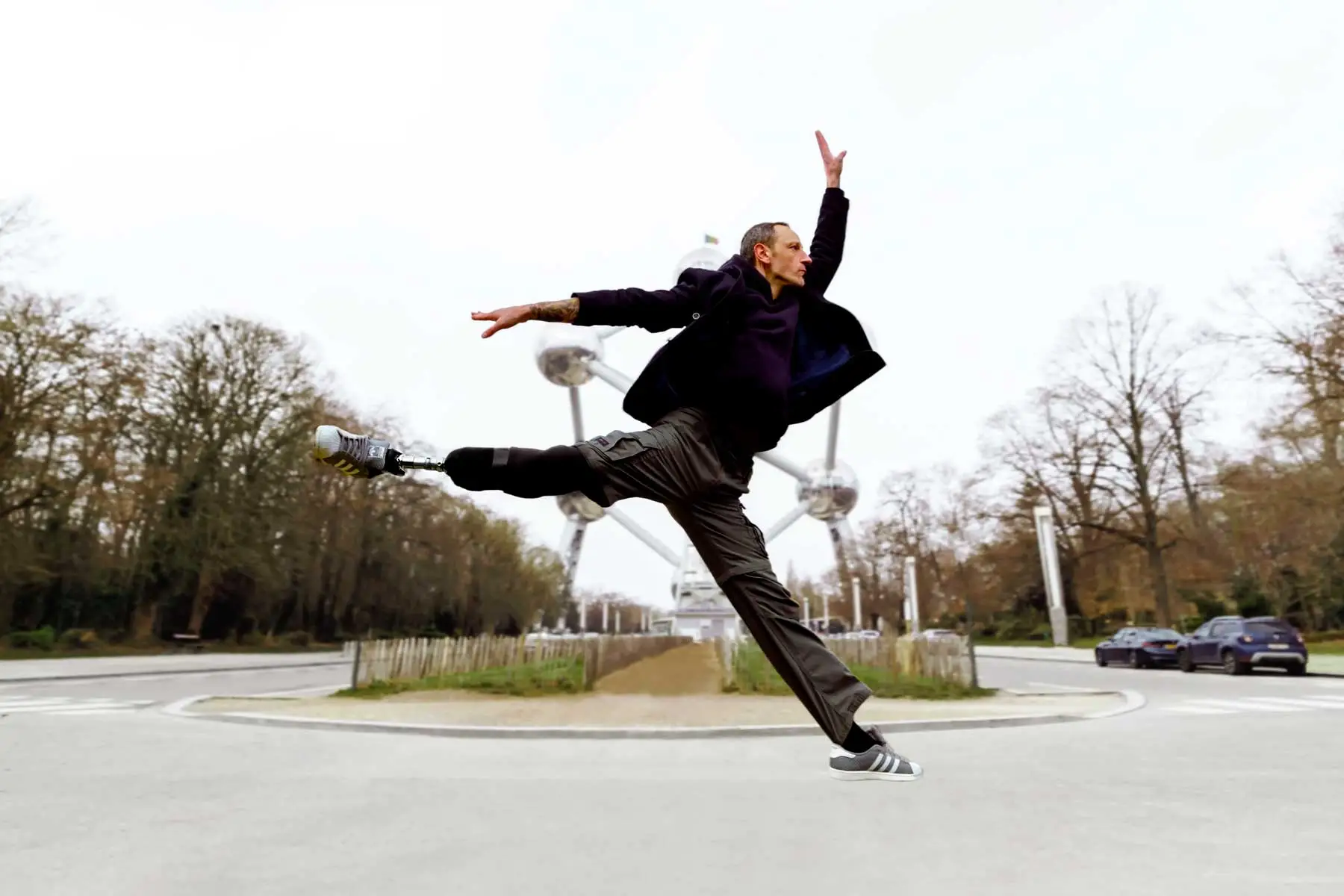
Every step sends a shock wave through the body.
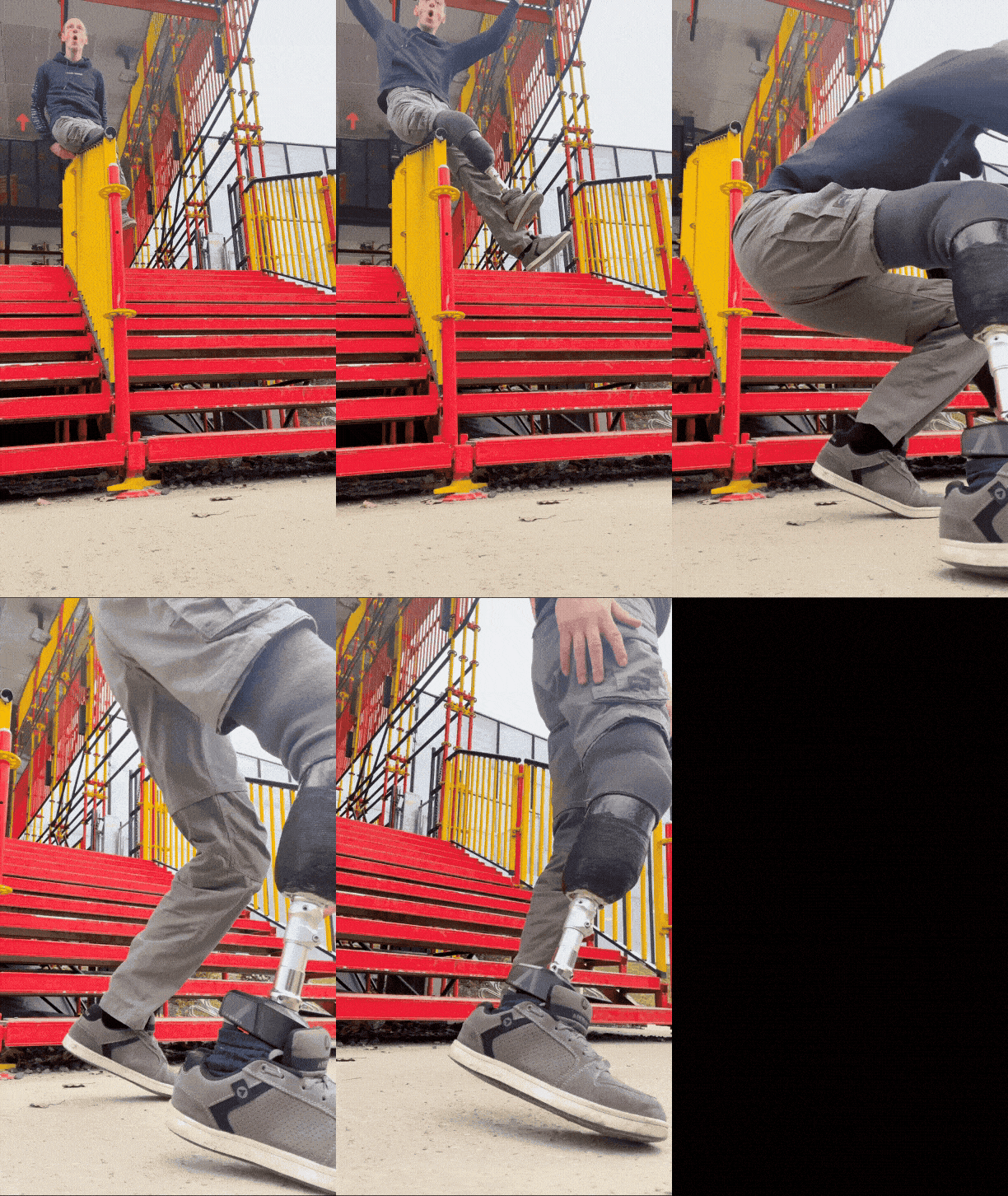
For many prosthetic users, harsh heel impact can affect comfort, stability, and even back health over time. Shock absorption in prosthetic feet directly influences prosthetic foot comfort and long-term joint loading.
When your heel touches the ground, known as heel strike, forces travel upward through the body in milliseconds. How those forces are managed influences walking comfort and long-term joint stress.
Shock absorption in prosthetic feet is often described as a feature. But biomechanics shows it is not simply about adding a shock absorber. It is about how the entire system responds at the moment impact begins.
To understand how impact can be reduced in a prosthetic foot, we first need to look at how the human body naturally manages shock.
The human body behaves like a coordinated shock-management system.
At heel strike, when the heel contacts the ground, it is generating a rapid impact peak from ground reaction forces.
Impact is not absorbed in one location. Instead, it is distributed across the lower limb:
Muscles actively control movement. Tendons store and release energy. Soft tissues compress and dampen vibrations.
The result is remarkable.
Only 8 to 15 percent of the shock applied at the heel reaches the head. Most impact is filtered before it travels upward.
When this natural coordination is reduced, vibrations propagate more directly through the body. Over time, increased impact transmission has been associated with:
Human biomechanics therefore provides a clear reference: effective shock absorption spreads and filters impact early, at ground contact.
Shock absorption in prosthetic feet refers to how effectively a prosthesis reduces impact at heel strike before it travels through the residual limb and up the body.
Effective shock management helps to:
Impact is not only about force. It is also about how abruptly that force is transmitted. That abruptness is often described as acceleration.
Managing shock means both reducing force and smoothing how quickly impact travels upward.
.gif)
When discussing impact, force is only part of the story.
Acceleration describes how abruptly impact is transmitted through the system. Even if force is reduced, a sharp acceleration spike at heel strike can still feel harsh.
Managing heel-strike acceleration means smoothing impact at the exact moment it occurs, not only reducing force elsewhere in the limb.
This is where ground-level shock management becomes critical.
In many prosthetic designs, shock absorption is achieved through vertical compression through Shock Absorbing Pylons (SAPs) mounted at the pylon or included directly at the top of the prosthetic foot.
They compress under load with the goal of reducing force transmitted to the residual limb.
Research shows SAPs can reduce up to 60% of transmitted force, and many users report a softer walking sensation.
However, when researchers measure objective changes in walking mechanics, results often show limited differences in walking speed, gait symmetry, or heel-strike acceleration.
Benefits are most noticeable in young, highly active amputees walking at faster speeds.
For users prioritizing stability, vertical compression can actually impair control.
This suggests that vertical shock absorbers address only part of the overall shock absorption challenge in prosthetic feet. Moreover, adding a component at the pylon level or at the top of the prosthesis increases weight and bulk, which can also negatively impact walking comfort.
Looking for the full measurement data and mechanical interpretation? The complete technical white paper explores this in detail.
To understand these limits, the prosthesis must be considered as a complete mechanical system.
A prosthetic limb includes:
These two elements behave like springs in series. In such systems, the softer element largely determines how impact is distributed.
In practice, the socket interface is often more compliant than the SAP. This means a significant portion of deformation and energy dissipation already occurs at the residual limb level.
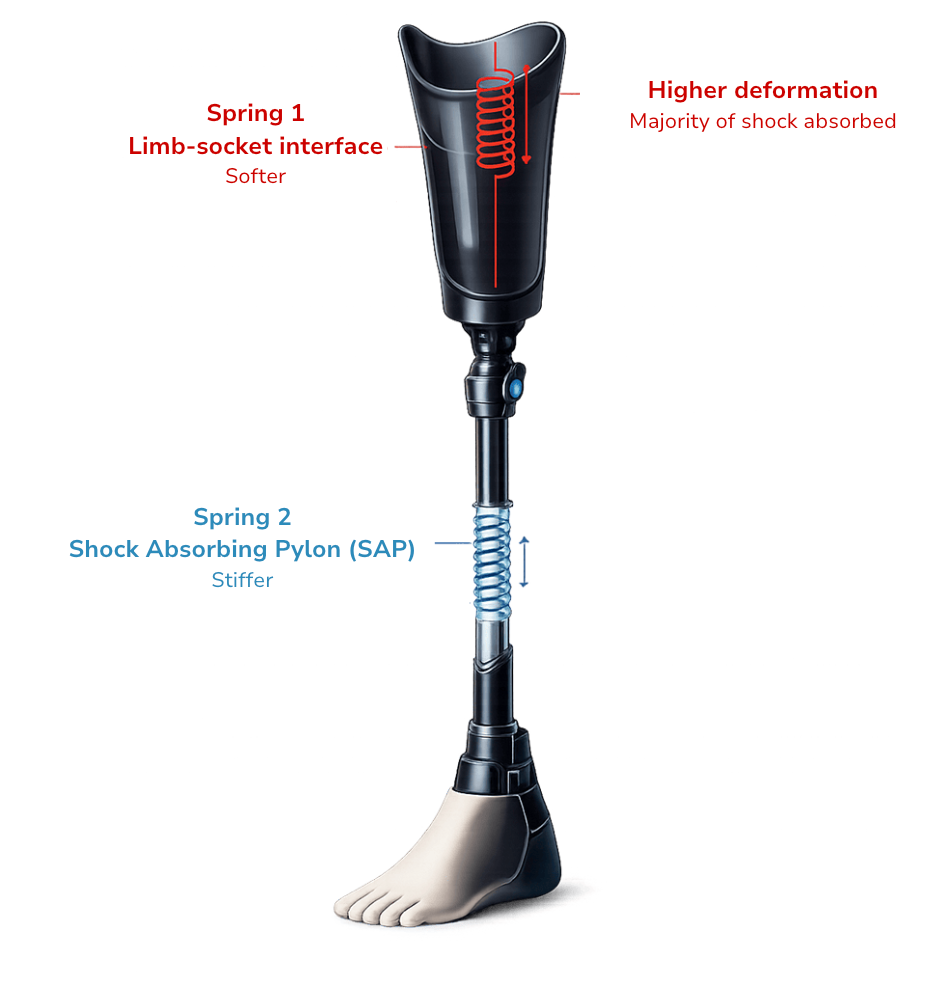
As a result, modifying vertical stiffness higher in the prosthesis may only partially influence global impact transmission.
Shock absorption in prosthetic feet is therefore a system-level issue. It depends on how all components work together.
If impact begins at heel strike, shock management should begin there too.
This principle guided the design of the Lunaris prosthetic foot.
During heel strike:
Instead of transmitting force purely vertically, energy is redistributed directly at ground contact.
This creates a response closer to how the natural ankle manages shock.
.gif)
Shock absorption is not only about joints. Materials matter.
The Lunaris 3D-printed functional foot cover contributes through:
.gif)
Made from TPU, a flexible and durable material commonly used in high-performance components, the foot cover gradually deforms under load and then returns to shape.
This provides:
Together, these mechanisms smooth impact at heel strike without adding weight and bulk to the prosthesis.
Internal measurements show that Lunaris reduces peak acceleration at heel strike from 5 g to 1.71 g. 1 g corresponds roughly to the acceleration caused by gravity when standing still on Earth. At heel strike, the body can briefly experience several times that level of acceleration.
Peak acceleration reflects how abruptly impact is transmitted through the prosthesis at ground contact. The higher this value, the more sudden and intense the shock.
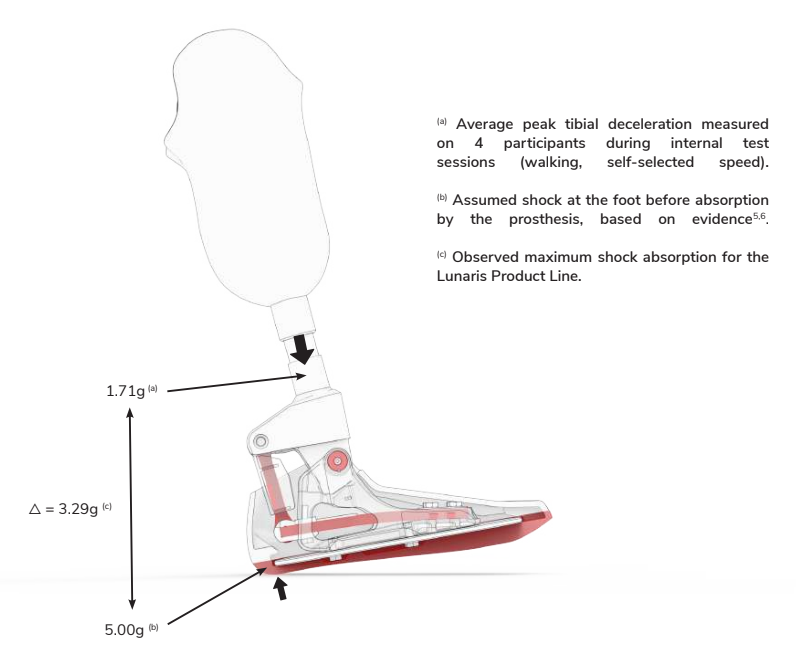
This reduction from 5 g to 1.71 g represents a 66% decrease in peak heel-strike acceleration.
In practical terms, ground contact becomes significantly smoother and less abrupt.
By managing shock directly at ground contact, the system limits how much sudden force travels upward toward the residual limb and the rest of the body.
Importantly, this performance is achieved without adding extra shock-absorbing components above the foot.
The design remains lightweight, compact, and mechanically coherent.
Impact management is closely linked to stability. Reducing vertical shock is only part of the equation, the foot must also adapt naturally to the ground.
The Lunaris foot cover is designed to allow controlled side-to-side movement and torsion, similar to the natural behavior of the human ankle–foot complex:
Because this adaptation occurs directly at ground level, the prosthesis conforms to irregular terrain instead of forcing the body to compensate higher up in the kinetic chain.
This supports both comfort and confidence in daily use.
Shock absorption begins at heel strike.
While vertical shock absorbers can provide benefits in certain situations, managing impact where it originates offers a more integrated approach.
The Lunaris system combines:
Shock absorption is not a component. It is a coordinated system.


.jpg)
.jpg)
